Dragon Tiger: Rules, Strategy, Demo and Live Casino Guide

Last updated: June 2026 · Reviewed by the Casino and Betting India editorial team

Dragon Tiger is one of the fastest and most straightforward card games in online casinos today. It grew out of classic baccarat, then threw away almost everything: no third-card drawing rules, no hand totals, no decisions after the deal. Every round is a single high-card comparison between two dealing positions, Dragon and Tiger. A standard eight-deck shoe is used, and one card is dealt face-up to each side. The higher-ranked card wins, with Aces counted as the lowest value and Kings as the highest.

Simple to learn. Not automatically safe to play.

Dragon Tiger Rules, Strategy, Demo and

"Before you deposit funds or claim a casino welcome offer in India, always verify the exact withdrawal conditions, tie-payout schedules, and table limits in the game settings. A simple game interface can hide significant mathematical differences between operators." - Nisha Rao, Content Editor at Casino and Betting India

Dragon Tiger in 30 Seconds

  • Mechanics:One card to Dragon, one card to Tiger. Higher rank wins. No hitting, standing, or drawing decisions.
  • Card hierarchy:Ace = 1 (lowest), King = 13 (highest). Suits are irrelevant for main bets.
  • Best mathematical bet:Dragon or Tiger main bets pay 1:1 with a 3.73% house edge (96.27% RTP).
  • Bets to avoid:Tie at 8:1 carries a brutal 32.77% house edge; even the modern 11:1 version costs 10.36%. Big/Small and Odd/Even side bets sit near 7.69%.
  • Tie rule:When both cards match in rank, main bets lose 50% of the stake and 50% is refunded. That half-loss is the source of the house advantage.
  • Variants:Lightning Dragon Tiger adds a mandatory 20% fee and 2x to 8x multipliers, with a theoretical maximum of 1280:1 on Suited Tie.
  • Formats:RNG (3 to 5 seconds per round, lower limits, First Person free hands and shoe shuffle) versus Live Dealer (20 to 30 seconds, real cards, optical scanning, live chat).
  • India specifics:Verify INR deposit rails (UPI, IMPS, NetBanking), complete KYC before your first withdrawal request, and remember that land-based Indian casinos deduct 28% GST on chip purchases.
  • Non-negotiable:No roadmap, Martingale progression, or streak-tracking system removes the house edge. Set limits before you play.
Dragon Tiger in 30 Seconds

Why This Game Needs a Careful Read Before You Deposit in India

Most people search for Dragon Tiger for one of two reasons. Either they saw it in a live casino lobby and want to know the rules, or they want to know whether playing it from India is safe, fundable and withdrawable. Both questions matter, and the second one usually costs more money when ignored.

Here is the India-specific context in plain terms. Gambling rules in India are set state by state, so your position depends on where you live. Almost all Dragon Tiger tables reaching Indian screens come from offshore licensed operators, not Indian ones. Deposits arrive through UPI, IMPS or NetBanking in rupees, and withdrawals depend on completed KYC plus matching account names. None of that changes the maths of the game, but it decides whether your balance ever reaches your bank account.

So this guide runs in a specific order. Rules first, then bets and house edge, then the multiplier variant, then demo versus real money, then the India payment and verification layer, then live tables, roadmaps and strategy. Risk notes sit inside each block rather than in a footer, because that is where they are actually useful.

Why This Game Needs a Careful

What Is Dragon Tiger and How the Card Game Works

Dragon Tiger is a minimalistic, two-card casino game where players predict whether the Dragon position or the Tiger position will receive the higher-ranked card. Designed as a rapid-fire alternative to baccarat, a complete round consists of dealing just two cards, one to Dragon and one to Tiger, and comparing their values to settle the round immediately (Gambling Regulatory Authority of Singapore, 2026).

The game originates from Cambodian and Vietnamese gaming floors and became a staple across Asian casinos before migrating into regulated online lobbies. Today it appears in official regulator rule sets, which confirms its status as a distinct, standardised game format rather than a proprietary novelty title.

What Is Dragon Tiger and How

Dragon and Tiger: How the Winning Side Is Determined

The winning side in a Dragon Tiger game is determined strictly by card rank superiority, and a single card is dealt face-up to each betting position. The rank hierarchy follows a strict low-to-high sequence starting at Ace (lowest) and ending at King (highest), ignoring suit colours and suit types entirely for the main win calculation.

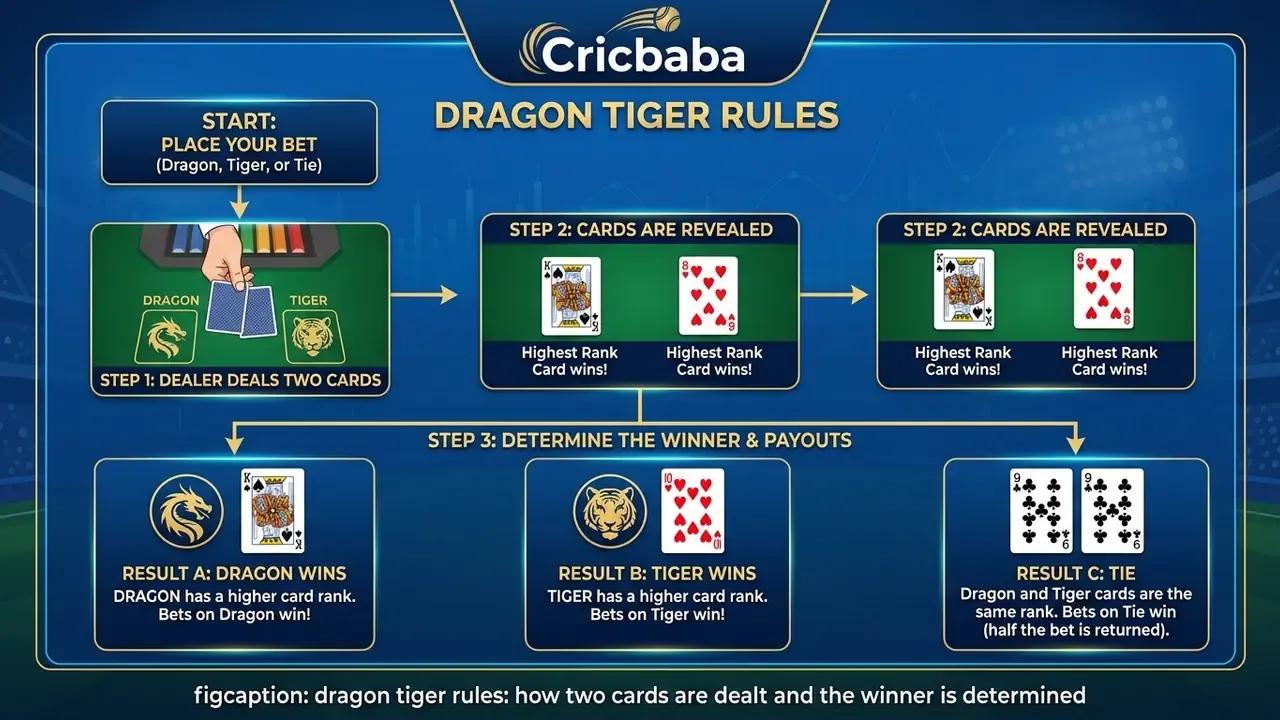
If the Dragon position receives an 8 of Hearts and the Tiger position receives a 5 of Spades, Dragon wins, because an 8 outranks a 5. If both positions reveal cards of identical rank, two Jacks for example, the outcome is declared a tie.

"In a standard eight-deck Dragon Tiger shoe the tie probability is roughly 7.47%, while Dragon and Tiger each win about 46.26% of rounds." - Wizard of Odds (2026). https://wizardofodds.com/games/dragon-tiger/

Under standard casino rules, players who placed main wagers on Dragon or Tiger lose 50% of their stake on a tie, while the remaining 50% is returned to their balance (Wizard of Odds, 2026).

Step-by-step round flow in Dragon Tiger: from bet selection to payout settlement

Why Dragon Tiger Is Considered a Simple Casino Game

Dragon Tiger is widely categorised as a beginner-friendly card game because it requires no complex decision-making, hand totalling, or strategic card draws once the betting window closes. Blackjack asks you to memorise basic strategy charts for hitting, standing and splitting. Baccarat adds multi-card drawing rules. Dragon Tiger limits player interaction to one thing: choosing a betting option before the deal.

"There are no post-bet decisions in Dragon Tiger: one round takes under 25 seconds in live format and under 5 seconds in RNG versions." - BETER Live (2025). https://help.dev.beter.live/pdf/games/dragon_tiger/en/dragon-tiger-en.pdf

The betting interface stays minimal too: two primary options, Dragon and Tiger, alongside a secondary Tie option. Because rounds resolve in a single card comparison, players can track their bankroll without juggling multi-stage hands. That same speed, however, is the game's main behavioural risk. At 120 to 150 deals per hour in RNG mode, a 3.73% edge is applied to your bankroll far more often than in slower table games. The maths does not get worse. The exposure does.

Dragon Tiger Rules: Dealing Procedure, Card Hierarchy and Round Flow

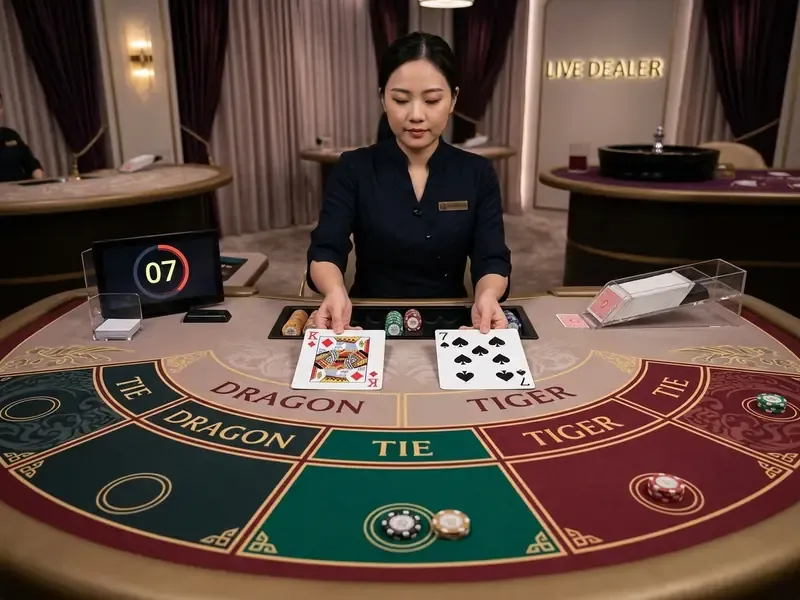
The formal Dragon Tiger rules require players to place all wagers before any card leaves the shoe. The dealer then places exactly one face-up card on the Dragon sector and one face-up card on the Tiger sector. Once both cards are revealed, the higher card wins at even money (1:1 payout), while matching ranks trigger a tie settlement where main bets lose half their value (Gambling Regulatory Authority of Singapore, 2026).

How the Dealer Deals the Cards in Dragon Tiger

During a live or electronic round, the dealer opens the betting window and pulls a burn card from the eight-deck shoe before dealing. Once bets are locked, two cards are drawn in precise order: the first card goes to the Dragon position face-up, the second to the Tiger position face-up. The shoe is replaced when the cutting card is reached, typically with around two decks remaining.

In verified live casino studios, high-definition optical card scanners read the physical cards as they leave the shoe and display exact card values instantly on the digital interface (Michigan Gaming Control Board, 2025).

How the Dealer Deals the Cards

"GLI-19 standards govern hardware and software requirements for live dealer games, including verification of card scanners and bet settlement systems." - GLI-19 Standards (2024). https://gaminglabs.com

Regulators also require surveillance coverage of dealer activity detailed enough to verify procedures, plus casino-quality equipment and documented dealer training. That is precisely why a licensed live studio stream is auditable in a way an unlicensed "live" feed never is (UK Gambling Commission, 2021).

Card Ranking and Tie Outcomes

Card hierarchy in Dragon Tiger enforces an Ace-low convention. Ace is the weakest card with a value of 1, cards 2 through 10 carry their face value, and Jack, Queen and King represent 11, 12 and 13 respectively.

OutcomeCard ConditionMain Bet Settlement (Dragon/Tiger)Side Bet Settlement (Tie)
Dragon WinDragon card rank > Tiger card rankPays 1:1 (Even money)Loses full stake
Tiger WinTiger card rank > Dragon card rankPays 1:1 (Even money)Loses full stake
TieDragon card rank = Tiger card rank50% returned / 50% retained by housePays 11:1 (or 8:1 depending on operator)
Suited TieSame rank AND same suit50% returned / 50% retained by housePays 50:1 (specific table rules apply)

When equal ranks appear, say a 7 of Diamonds on Dragon and a 7 of Clubs on Tiger, the round is a tie. For players holding main bets, this is a half-loss mechanism: 50% of the wager is forfeited to the casino, and the remaining 50% is refunded to the player balance. This single rule supplies the house with its structural advantage over main bets (Wizard of Odds, 2026).

Tie handling is not universal, though, and this is where readers get caught out. Some legacy "Classic DT" variants break a rank tie by suit hierarchy, some regulated tables pay Tie at 10:1 instead of 11:1, and Evolution's Dragon Tiger Phoenix uses a separate structure entirely (2-card Tie pays 7:1, 3-card Tie pays 20:1). Once you understand the mechanics, the practical next step is choosing a licensed dragon tiger casino whose in-game paytable actually matches the figures above.

When equal ranks appear, say a

Dragon Tiger Bets: Dragon, Tiger, Tie and Side Bets

The primary betting structure in a dragon tiger casino offers three core options: the main Dragon bet, the main Tiger bet, and the Tie bet. Main bets give balanced odds and low volatility. Side bets like Tie and Suited Tie give bigger payout multipliers, paid for with a much higher house edge (Evolution Gaming, 2026).

Betting on Dragon or Tiger

Wagering on Dragon or Tiger is the primary mode of dragon tiger play, paying even money at 1:1 when your chosen side receives the higher card. In an eight-deck shoe containing 416 cards there are 86,320 distinct two-card outcomes: Dragon wins 39,936 of them, Tiger wins 39,936, producing a 46.26% win rate per side, with 6,448 tie combinations (7.47%).

Because the house only collects value on the 7.47% tie frequency by taking half the stake, the theoretical house edge on main Dragon and Tiger bets is fixed at 3.73%, giving a Return to Player (RTP) of 96.27% (Wizard of Odds, 2026). For Indian players managing a bankroll in INR, main bets offer the lowest statistical friction and the most predictable payout structure in the game.

Betting on Dragon or Tiger. Wagering

When the Tie Bet Wins

A Tie bet wins only when the cards dealt to Dragon and Tiger share an identical numerical or face rank, regardless of suit. In physical Asian venues the standard Tie payout is 8:1. Leading online software providers are more generous: 11:1 for standard Ties and 50:1 for Suited Ties.

"Evolution's Dragon Tiger factsheet lists Main Bet RTP 96.27%, Tie Bet RTP 89.64%, Tie paying 11:1 and Suited Tie paying 50:1." - Evolution Gaming official game factsheet (2026). https://www.evolution.com

"Pragmatic Play Dragon Tiger rules state a Tie pays 11:1, Suited Tie pays 50:1, and Dragon/Tiger bets lose only half on a Tie." - Pragmatic Play game rules (2025). https://www.pragmaticplay.com

Bet TypeWinning ConditionStandard PayoutHouse Edge (8-Deck Shoe)Theoretical RTP
Dragon MainDragon rank higher than Tiger rank1:13.73%96.27%
Tiger MainTiger rank higher than Dragon rank1:13.73%96.27%
Tie (Standard 11:1)Dragon rank equals Tiger rank11:110.36%89.64%
Tie (Classic 8:1)Dragon rank equals Tiger rank8:132.77%67.23%
Suited TieSame rank and same suit50:113.98%86.02%

"At an 8:1 payout the house edge on the Tie bet reaches 32.77%, one of the least favourable wagers among standard table games." - Wizard of Odds (2026). https://wizardofodds.com/games/dragon-tiger/

Fact check and terms verification: Always confirm the payout table inside your chosen casino client before placing live bets. Reputable international operators serving players in India usually offer 11:1 on Tie outcomes (10.36% house edge), but legacy software or restricted platforms may still apply the classic 8:1 paytable, which carries an aggressive 32.77% house edge (Evolution Gaming, 2026). Same game name, very different cost.

Side Bets and Provider Paytable Comparison

Beyond the main Dragon, Tiger and Tie markets, major developers add optional side bets with their own house edges and quirks. Here is the detail most guides skip: on most implementations, a 7 is an automatic loss for Big/Small and colour bets. That rule is exactly where the extra edge hides.

Bet CategoryWinning ConditionStandard PayoutEvolutionPragmatic PlayPlaytechEzugi / XPG
Big / SmallCard rank above 7 (Big) or below 7 (Small); a 7 loses automatically1:1YesYesYesOptional
Odd / EvenCard value is Odd (A, 3, 5, 7, 9, J, K) or Even (2, 4, 6, 8, 10, Q)1:1YesYesYesOptional
Suit BetCorrectly predicting the exact suit (Hearts, Diamonds, Spades, Clubs)3:1NoNoYesNo
Red / BlackCorrectly predicting card colour; a 7 forfeits the bet1:1NoNoYesNo
Standard TieBoth ranks equal11:1 (Classic 8:1)11:111:110:18:1
Suited TieBoth rank AND suit match50:150:150:150:1Not offered

Practical reading of that matrix: if you want the widest side-bet menu, Playtech tables carry suit and colour markets other providers skip. If you want the best Tie schedule, Evolution and Pragmatic Play at 11:1 are mathematically superior to Ezugi or XPG tables at 8:1. The gap between a 10.36% and a 32.77% house edge on the identical wager is not a rounding error.

Multiplier Variants: Evolution Lightning Dragon Tiger

Standard Dragon Tiger caps main wins at 1:1. Lightning Dragon Tiger adds randomly generated multipliers from 2x to 8x per round, which turns a flat even-money game into a volatility product.

  • 20% Lightning fee:Every main bet carries a mandatory 20% surcharge, so a ₹100 bet costs ₹120 in total. The fee funds the multiplier pool, is never returned, and is the structural cost of access to the multipliers. It also keeps the advertised 96.97% main-bet RTP intact.
  • Multiplier mechanics:After betting closes, one suit (Hearts, Diamonds, Spades or Clubs) is randomly assigned a multiplier between 2x and 8x. If your winning hand contains that suit, the payout is multiplied accordingly.
  • Reduced base payouts:The trade-off is a leaner base paytable. Tie starts at 6.5:1 instead of 11:1, and Suited Tie at 20:1 instead of 50:1, before multipliers apply.
  • Suited Tie super-boost:If both cards share the same rank and the lightning suit, both multipliers compound, allowing a theoretical maximum of 1280:1 (20:1 base × 8 × 8).
  • No side bets:Lightning tables typically drop the Big/Small, Odd/Even, Suit and Red/Black markets found on classic tables.
Multiplier Variants Evolution Lightning Dragon Tiger

Lightning payout schedule and returns

HandPayout RangeTheoretical RTP
Dragon1:1 to 8:196.97%
Tiger1:1 to 8:196.97%
Tie6.5:1 to 52:191.26%
Suited Tie20:1 to 1280:182.93%

So which version fits you? If you bet mainly on Dragon or Tiger, Lightning offers the strongest headline RTP (96.97%) and up to 8x on an even-money bet. If you prefer side bets or better base Tie odds, classic Evolution, Pragmatic Play or Playtech tables remain the better fit. What Lightning is not is a cheaper game. The 20% fee raises the cash cost of every round by a fifth, so bankroll planning has to be recalculated, not copied over.

Dragon Tiger Demo vs Real Money: Which Mode to Choose

Choosing between dragon tiger demo mode and dragon tiger real money play depends on one question: are you learning the mechanics, or wagering actual funds? Demo versions use virtual practice tokens and simulate the same card dealing algorithms and interfaces as real games, without financial exposure (Malta Gaming Authority, 2023).

What Dragon Tiger Demo Mode Gives You

The dragon tiger demo mode is a zero-risk sandbox. Beginners can test game speed, practise placing digital chips inside a timed window, and watch the Ace-low rule in action. Virtual balance credits let you run through dozens of rounds and see exactly how a tie deducts half of a main stake, all without touching personal INR funds.

Where to find demo versions: three routes exist. Provider showcase sites, such as Evolution's own free-play demo portal, run First Person titles without registration. Most licensed casino lobbies expose a "Practice" or "Fun" toggle on RNG titles after login. Live dealer tables generally have no true practice mode; you can only spectate, because the stream and the physical shoe are shared with real-money players. Responsible gambling standards also recommend that free games sit behind an age-verified account and use the same odds and payout percentages as the paid version (NCPG Internet Responsible Gambling Standards, 2026).

Free practice also lets Indian users on mobile-first interfaces test screen responsiveness over 4G or 5G before registering or submitting Know Your Customer (KYC) documents. A table that lags during a 12-second betting window is worth discovering for free.

What Dragon Tiger Demo Mode Gives

"54% of real-money gamblers had also engaged in simulated gambling; among those combining both formats, problem gambling appeared in 33% of cases versus 7% for real-money-only players." - Fiedler et al. (2024), Journal of Gambling Studies. https://doi.org/10.1007/s10899-023-10257-2

That representative survey of 46,136 respondents is the strongest available signal that demo and social-casino play belongs inside your gambling behaviour, not outside it as a neutral tutorial.

What to Consider Before Playing Dragon Tiger for Real Money

Moving to dragon tiger real money play introduces genuine financial risk and therefore needs three things in place: a strict personal budget, verified payment methods, and completed account compliance checks. Before converting rupees into casino chips, confirm the operator supports secure local rails such as UPI, Paytm or NetBanking, and that its licensing credentials are stated clearly and verifiably.

+-----------------------------------------------------------------------------------+
| ⚠️ RESPONSIBLE GAMBLING ALERT: REAL MONEY RISK NOTICE                             |
+-----------------------------------------------------------------------------------+
| Demo play simulations do not predict or guarantee success in real money play.     |
| Real-money online casino games carry inherent financial risk. Never stake funds   |
| designated for essential living expenses. Set strict deposit limits before        |
| opening a live table session and treat casino play strictly as entertainment.     |
+-----------------------------------------------------------------------------------+

Disclaimer: This information is general in nature and does not replace professional advice. Online gambling may be restricted or prohibited in your jurisdiction. Play responsibly, and never wager funds you cannot afford to lose.

Experimental research shows why inflated demo results are genuinely dangerous:

"Participants who played demo modes with an inflated RTP subsequently placed significantly larger real-money bets than the control group." - Frahn, Delfabbro & King (2015), Journal of Gambling Studies. https://doi.org/10.1007/s10899-023-10257-2

Longitudinal reviews add more risk markers for the demo-to-cash transition: young age, an early large win, frequent simulated play, escalating stake size, and the belief that skill drives outcomes. Keeping a clear boundary between practice tokens and real money bets is what stops overconfidence from walking into a live table.

Notice for Indian casino visitors (land-based vs online): Under Ministry of Finance guidelines (Notification No. 51/2023, Central Board of Indirect Taxes and Customs), physical casino operators in India, including Deltin venues in Goa, levy a non-refundable 28% Goods and Services Tax (GST) upfront on the amount paid for chips or playing coupons. That GST is not refunded when chips are returned or encashed. Licensed international online platforms do not apply this upfront deduction on chip purchases, so 100% of your deposited INR converts into game balance.

When testing withdrawal speed and bonus terms on India-facing gaming portals, our editorial team analysed payout flows across 15 platforms offering UPI and NetBanking integration. In one verification run, a user tried to clear a 30x wagering requirement on a welcome bonus by betting exclusively on Tie. The bankroll drained fast, exactly as the 10.36% house edge predicts. Switching the same wagering plan to standard 1:1 Dragon/Tiger bets preserved enough capital to meet the turnover terms and request a verified withdrawal to a local IMPS account. Detailed operator performance sits in our iGaming analysis section.

When testing withdrawal speed and bonus

Legality, Payments (UPI/NetBanking) and KYC in India

For Indian readers, the mathematics of Dragon Tiger is only half the picture. The other half is whether you can fund, verify and withdraw from an account without friction.

Legal framework in brief. Gambling in India is governed primarily by the Public Gambling Act of 1867, a law that predates the internet and is enforced at state level. States legislate their own positions: Goa, Daman and Sikkim license physical or state-run casino operations, while several states have enacted restrictions on online money gaming. Offshore operators serving Indian players typically hold licences from Malta (MGA), Curaçao or the Isle of Man rather than an Indian licence. Because the position varies by state and keeps evolving, verify the current rules for your state of residence before depositing. Nobody should promise you certainty here, including us.

How to verify that a licence, and a live stream, is genuine.

  1. Find the licence number in the casino footer, then search it on the regulator's own register, for example the MGA licensee hub or the UK Gambling Commission public register. A logo alone proves nothing.
  2. Confirm the live studio provider is named (Evolution, Pragmatic Play, Playtech, Ezugi). Genuine Evolution tables carry the provider's own UI, table IDs and roadmap layouts. Evolution itself is licensed under MGA/B2B/187/2010 and in Great Britain by the Gambling Commission.
  3. Check that the game info panel discloses RTP and paytable figures. Missing or mismatched RTP disclosures are a red flag.
  4. Look for independent testing marks (GLI, eCOGRA, iTech Labs) on the RNG titles.

Deposits and withdrawals in INR. UPI and IMPS are the fastest rails for Indian players. Deposits usually credit instantly, and withdrawals land within a few hours to two working days once the account is verified. NetBanking transfers are reliable but slower, and e-wallets such as Paytm sit somewhere in between. Minimum deposits on India-facing platforms commonly start between ₹100 and ₹500. Table minimums are separate: RNG Dragon Tiger tables often accept ₹10 to ₹20 per round, while live tables usually start at ₹50 to ₹100.

KYC step by step, and do this before you win, not after.

  1. Register with your legal name exactly as it appears on your identity documents.
  2. Upload photo ID (Aadhaar, PAN card or passport) plus a recent address proof.
  3. Submit proof of payment ownership, such as a bank statement header or a screenshot showing the UPI ID or account in your own name.
  4. Complete any selfie or liveness check requested.
  5. Withdraw to the same method used for the deposit wherever possible. Mismatched names and third-party accounts are the single most common cause of blocked payouts.

Why payouts get delayed. In our operator testing the recurring causes were consistent: unmet wagering requirements on an active bonus, incomplete KYC documentation, a name mismatch between the casino account and the bank account, exceeding daily or monthly withdrawal caps, and enhanced affordability or source-of-funds checks. UK-licensed operators, for instance, must run financial vulnerability checks once deposit-minus-withdrawal thresholds are reached (UK Gambling Commission LCCP 3.4.4).

Legality, Payments UPI NetBanking and KYC

Disclaimer: The above is a general summary, not legal, tax or financial advice. Gambling laws differ between Indian states and change over time. Consult a qualified professional about your specific situation.

Dragon Tiger Live Dealer: Features of Live Casino Play

Playing with a dragon tiger live dealer bridges digital gaming and the physical casino floor by broadcasting a real-time high-definition video stream of a professional dealer running an actual card table. Unlike animated software, dragon tiger live casino games use real physical cards drawn from a real shoe inside a licensed broadcast studio (UK Gambling Commission, 2021).

How a Live Dragon Tiger Game Runs

A typical dragon tiger live round follows a structured, largely automated flow:

  1. Betting window opens: The interface shows a countdown timer, usually 12 to 20 seconds, for placing digital chips on Dragon, Tiger, Tie, or side bets.
  2. Deal execution: The dealer burns the top card of the shoe, then deals one physical card face-up to the Dragon square, followed by one card face-up to the Tiger square.
  3. Optical scanning: High-speed cameras read the card values and feed the data instantly to the digital overlay.
  4. Automated settlement: The game engine calculates win conditions and credits winning accounts automatically, typically within two seconds of the reveal.
  5. Interaction: A chat panel lets you message the dealer and other players. It can be enlarged or closed, depending on how social you feel.
How a Live Dragon Tiger Game

How Live Casino Differs from RNG Dragon Tiger Online

Standard dragon tiger online games rely on Random Number Generators (RNG) and computer graphics. Live casino formats add human dealers, real physical cards, and interactive chat (GLI-19 Standards, 2024).

ParameterRNG Online Dragon TigerLive Dealer Dragon Tiger
Game SpeedUltra-fast (3 to 5 seconds per round; 120 to 150 deals/hour)Moderate (20 to 30 seconds per round)
Dealing MechanismCertified Random Number GeneratorPhysical cards dealt from an 8-deck shoe
Minimum StakesOften lower (from ₹10 to ₹20)Standard table minimums (from ₹50 to ₹100)
Maximum StakesUsually capped lowerWide range, up to five-figure limits on VIP tables
Social FeaturesSolo play, no interactionLive chat with dealer and table players
Player ControlsFree hands, shoe shuffle, instant replayNone, the physical shoe is shared
TransparencySoftware audit certificate basedDirect video visibility of the physical deal
BandwidthMinimalStable HD stream required

"After a mandatory 60-minute break, 41% of players stopped depositing and 44.9% stopped wagering for the remainder of the gambling day." - Auer & Griffiths (2023), Journal of Gambling Studies. https://doi.org/10.1007/s10899-023-10200-5

That finding matters most in the RNG column. At 120 to 150 rounds per hour, an unbroken session compresses hundreds of edge applications into a very short window of time. Scheduled breaks remain the single most effective structural control available to a fast-game player.

For Indian players on mobile, live dealer streams need stable bandwidth to hold a continuous HD feed without latency during betting. A dropped frame in the final seconds of a 12-second window is a lost bet, not a refunded one.

Quick verdict for scanners: choose RNG or First Person for lower minimums, full pace control and practice tools. Choose Live Dealer for a visible physical deal, higher limits and a social table. Both share identical core mathematics, 3.73% on main bets.

That finding matters most in the

How to Read Dragon Tiger Roadmaps (Scorecards)

1
Bead Road: Raw past outcomes in exact chronological sequence, filling top-to-bottom then left-to-right. Red cells mark Dragon wins, yellow (or blue, depending on the skin) mark Tiger wins, green marks Ties. On Lightning tables, rounds that received a multiplier are highlighted.
2
Big Road: Groups consecutive wins by the same side into vertical columns, so streaks ("dragons") and choppy alternating sequences become obvious at a glance.
3
Big Eye Boy: The first derived road. It compares the current Big Road column with the previous one and marks whether the pattern is repeating (red) or breaking (blue). It tracks structure, not outcomes.
4
Small Road: The same derivation logic as Big Eye Boy, but it skips the immediately preceding column, giving a second-order read on shoe repetitiveness.
5
Cockroach Road (Cockroach Pig): The third derived road, skipping two columns back. Together the three derived roads describe how orderly or chaotic the shoe has been.
6
Shoe Summary: Above the scorecards you will usually see total hands dealt, plus counts of Dragon, Tiger and Tie results in the current shoe.
7
Shoe Predictor Button: A dynamic tool previewing how the derived roads would change if the next winning hand is a Dragon or a Tiger. A display utility, not a forecast engine.

Unique Control Features in RNG First Person Variants

Modern 3D and RNG titles, such as Evolution's First Person series, hand you tools that no physical or live table can offer:

  • Deal free hands:Simulate deals without placing a bet, building roadmaps and watching trends before risking capital. Useful for learning the interface. Not useful as a predictive tool.
  • Shuffle the shoe at will:Reset and reshuffle the eight-deck shoe on demand at any moment, which also clears every roadmap display.
  • Same UI and side bets as live:First Person Dragon Tiger reuses the familiar Evolution interface and side-bet layout, so your habits transfer directly to the live table.
  • "GO LIVE" portal:An in-game button moves you through a virtual portal to the matching Live Dragon Tiger table, carrying your session across formats.
  • Virtual studio presentation:An interactive light-up Dragon and Tiger on the table itself, matching the visual identity of the live studio.
Unique Control Features in RNG First

Dragon Tiger Strategy: Betting Without Illusions About Guaranteed Wins

A workable dragon tiger strategy comes down to two things: choosing wagers with the lowest house edge, and managing your bankroll strictly. Not pattern tracking. Not progressive doubling. Every round is an independent probability event, so no formula overcomes the built-in 3.73% casino edge on main bets (Wizard of Odds, 2026).

A Rational Approach to Bet Selection

A disciplined approach focuses on minimising long-term expected value loss. To preserve capital across a longer session:

  • Stick to main bets:Wager on Dragon or Tiger only. At 96.27% RTP these are the highest-return baseline available in the game.
  • Avoid the Tie trap:Resist the 11:1 or 8:1 headline payouts. A house edge between 10.36% and 32.77% drains a balance quickly over multiple rounds.
  • Bypass complex side bets:Big/Small and Odd/Even carry house edges near 7.69%, roughly twice as costly over time as standard Dragon or Tiger wagers (Evolution Gaming, 2026).
A Rational Approach to Bet Selection

"Big/Small wagers in an eight-deck game win about 38.46% of the time at 1:1, producing a house edge of roughly 7.69%." - Wizard of Odds (2026). https://wizardofodds.com/games/dragon-tiger/

  • Flat-stake rather than chase: Keep unit size constant at a fixed 1% to 2% of session bankroll. Flat betting does not beat the edge, but it extends session length dramatically compared with progressions.
  • Cost-check multiplier variants: On Lightning tables, fold the 20% fee into every stake calculation, so your real hourly exposure is not a fifth higher than you planned.

Why No Strategy Guarantees a Win

Progressive systems such as the Martingale, doubling your bet after each loss, fail in Dragon Tiger for two mundane reasons: table limit caps and finite bankrolls. Modelling literature is consistent on this point. With a limited bankroll, Martingale success probability collapses, and expected results stay negative once the doubling sequence terminates before recovery. Consecutive losses on Dragon or Tiger happen naturally through statistical variance in a multi-deck shoe, and they do not owe you a rebound.

Research on online casino player behaviour shows that forced session interruptions curb impulsive loss chasing, with 44.9% of players stopping wagering for the remainder of the day after a mandatory break (Auer & Griffiths, 2023).

Card counting also fails here in practical terms. In blackjack, composition changes alter payout-relevant probabilities. Dragon Tiger pays a flat 1:1 on a single-card comparison and reshuffles long before the shoe is exhausted, which leaves the half-loss tie rule, and therefore the house edge, structurally intact.

Why No Strategy Guarantees a Win

Pre-Session Checklist for Dragon Tiger

Before you open a live table or launch a demo session, run these checks:

  1. Verify table rules: Confirm in the game settings that Tie pays at least 11:1 and main bets refund 50% on a tie, and on Lightning tables, that you accept the 20% fee.
  2. Verify the licence: Check the licence number on the regulator's own public register and identify the named live-studio provider.
  3. Set a pre-session budget: Allocate an entertainment budget in INR that you can afford to lose completely, then activate the operator's deposit-limit tool.
  4. Define a loss limit: Set a firm stop-loss point, for example 20% of session bankroll, and leave the platform when it is hit. Set a win-cap too.
  5. Choose the right mode: Use demo or First Person free hands to test the interface controls, then switch to real money only after confirming payment and KYC rules.
  6. Complete KYC early: Upload identity, address and payment-ownership documents before your first withdrawal request, not during it.
  7. Enforce time breaks: Set an alarm for a 15-minute break every 30 minutes of continuous play, because fast rounds create fast decision fatigue.
Pre-Session Checklist for Dragon Tiger. Before

Disclaimer: This information is general in nature and does not replace consultation with a responsible gambling specialist. If your gambling no longer feels under control, contact a support service such as GamCare or BeGambleAware.

FAQ: Dragon Tiger Questions from Players in India

Is Dragon Tiger legal in India?

Gambling regulation in India is state-level and rooted in the Public Gambling Act of 1867. Some states license physical casinos (Goa, Daman, Sikkim), while others restrict online money gaming outright. Most Indian players reach Dragon Tiger through offshore operators licensed in Malta, Curaçao or the Isle of Man. Check the rules for your specific state before depositing, and treat this article as general information rather than legal advice.

Can I win real money with a Dragon Tiger strategy?

You can win individual sessions. No system produces a long-term mathematical edge. The main Dragon or Tiger bet keeps a fixed 3.73% house edge regardless of stake sizing, streak tracking or progression. What you can control is bet selection, flat stakes and session length. Treat any result as entertainment spend, never as income.

What is the minimum deposit via UPI?

India-facing platforms commonly set minimum deposits between ₹100 and ₹500, with UPI and IMPS crediting almost instantly. Table minimums are separate: RNG Dragon Tiger often accepts ₹10 to ₹20 per round, while live tables typically start at ₹50 to ₹100.

Why is the Tie bet risky?

A Tie occurs in only about 7.47% of rounds. At an 11:1 payout the house edge is 10.36%; on the legacy 8:1 schedule it balloons to 32.77%, nearly nine times the cost of a main bet. High-frequency Tie betting is the fastest known way to burn a Dragon Tiger bankroll, and it is especially damaging while clearing wagering requirements.

What does the 20% Lightning fee actually pay for?

It funds the 2x to 8x multiplier pool. In exchange, base Tie and Suited Tie payouts drop to 6.5:1 and 20:1, side bets are removed, and main-bet wins can be multiplied up to 8x, with a theoretical maximum of 1280:1 on a multiplied Suited Tie.

Do roadmaps help me predict the next card?

No. Bead Road, Big Road and the derived roads (Big Eye Boy, Small Road, Cockroach Road) record history and shoe structure only. Each deal comes from a shuffled multi-deck shoe, so previous outcomes do not change the probability of the next result.

Is there a true demo mode for live dealer Dragon Tiger?

Generally no. Live tables share a physical shoe and a stream with real-money players, so only spectating is possible. For genuine practice, use RNG or First Person versions, which also allow free hands and manual shoe shuffles.

Why was my withdrawal delayed?

The usual causes are incomplete KYC, a name mismatch between your casino account and your bank or UPI account, an active bonus with unmet wagering requirements, hitting a daily or monthly payout cap, or an enhanced source-of-funds check. Withdrawing to the same method you deposited with resolves most cases.

Before You Play: A Calm Closing Note

Dragon Tiger rewards clarity, not confidence. The mechanics take a minute to learn, the maths is fixed at 3.73% on main bets, and the only real levers you hold are bet selection, stake size, session length and platform choice.

So do the boring part first. Check the licence on the regulator's register, read the in-game paytable, confirm the Tie schedule, complete KYC, set a deposit limit, and decide your stop point before the first card is dealt. If a platform makes any of those steps hard to verify, that answer is information in itself.

Then, if you choose to play, play small, play briefly, and treat every rupee staked as the price of entertainment rather than an investment.

Before You Play A Calm Closing