Roulette online: rules, bets, demo, and live dealer

Roulette is one of the easiest table games to open in a digital casino, and one of the easiest to misread. It runs on a fixed mathematical model: numbers 0 to 36 (or 00) decide every outcome on single-zero and double-zero wheels. Payout multipliers run from 35:1 on a straight-up number down to 1:1 on even-money outside bets, with a baseline house edge of 2.70% on single-zero European wheels and 5.26% on double-zero American wheels (Gambling Regulatory Authority, 2026, PDF: roulette game rules; Metropolitan Casinos, 2026, PDF: Double Zero American Roulette). Before you start a real-money session or claim a promotional offer, check four things: licensing, payout terms, payment friction, and the rules in your own state.


Roulette online rules, bets, demo, and

"A common mistake Indian players make when exploring online casino games is focusing on headline bonus amounts rather than withdrawal limits and game mechanics. Before placing your first bet, verify table limits, test the interface in demo mode, and understand the mathematical house edge behind each wheel format." Nisha Rao, Casino Content Editor, Casino and Betting India.

Key takeaways in 10 seconds

  • Wheel formats:European = 37 pockets (single 0), American = 38 pockets (0 and 00), French = 37 pockets plus La Partage / En Prison rules.
  • House edge:2.70% (European) vs 5.26% (American) vs 1.35% on even-money bets in French roulette. Prefer single-zero tables.
  • Payouts:Straight up 35:1, split 17:1, street 11:1, corner 8:1, six line 5:1, dozen/column 2:1, red/black, odd/even, high/low 1:1.
  • Formats:Demo (virtual credits, no withdrawals), RNG software (instant spins, stakes from ₹1 to ₹10), live dealer roulette (real croupier, HD stream, stakes usually from ₹50 to ₹100).
  • Multiplier variants:Lightning Roulette pays 29:1 straight up but adds 50x to 500x multipliers; XXXtreme reaches 2,000x; Mega Fire Blaze up to 10,000x.
  • Strategy reality:Martingale, Fibonacci, and D'Alembert reshape volatility but never change expected value. Table limits and finite bankrolls break every progression.
  • Before depositing:Check the licence (MGA, PAGCOR, UKGC), RNG certification, UPI/INR support, KYC rules, deposit limits, and roulette's bonus wagering weighting (often only 5% to 10%).
Key takeaways in 10 seconds

What is roulette and how the game is structured

Roulette is a classic casino game of chance. Where the ball settles on a spinning, compartmented wheel decides the round, and nothing else does. The game is a game of three parts: the physical or virtual roulette wheel, the marked roulette table layout, and the dealer (or the software engine) who accepts wagers, launches the ball, and settles payouts.

That is the whole machine. Everything else, from bonus rules to multiplier features, is built on top of it.

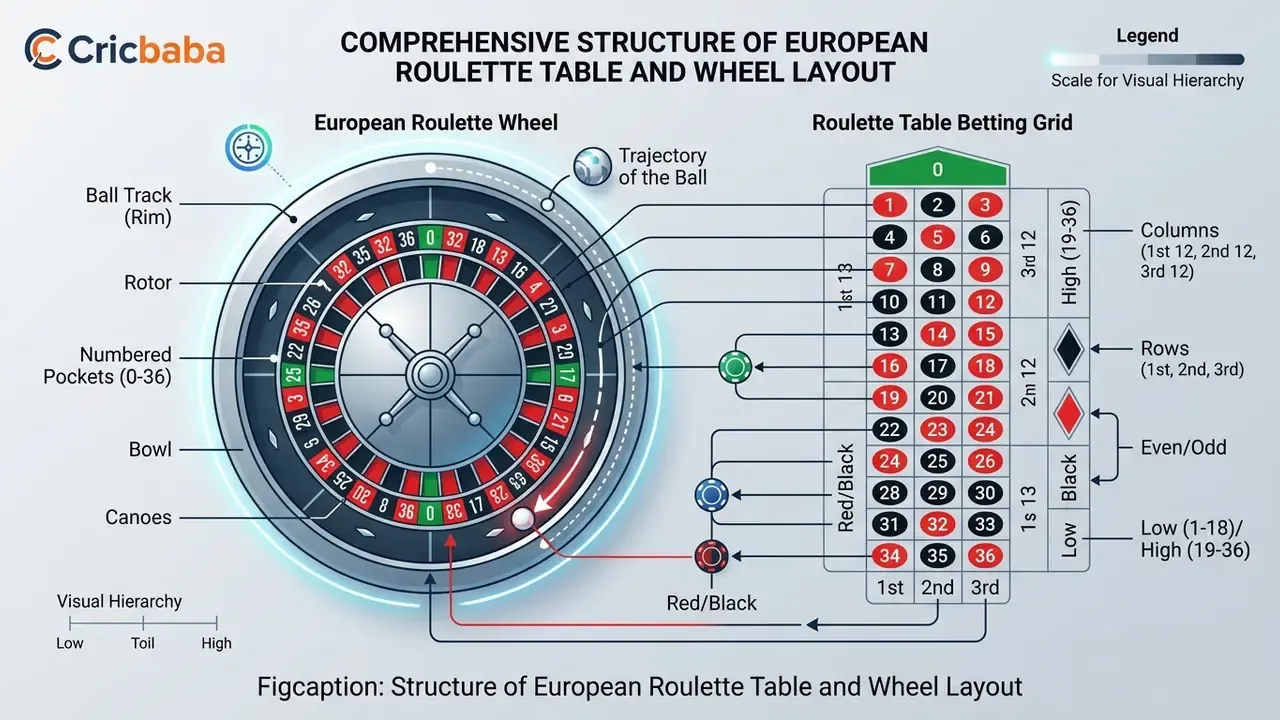
Diagram of a single-zero European roulette table and wheel layout showing inside and outside betting zones

Roulette wheel, ball, and roulette table

The roulette wheel is a precision-engineered device with either 37 or 38 equal-sized numbered pockets, shaped to catch the ball as momentum fades during wheels spinning. A standard European roulette wheel has 37 compartments: numbers 1 through 36 in alternating red and black, plus one green zero (0). An American roulette wheel carries 38 pockets, because of the extra green double zero (00) sector (Gaming Integrity, "Standards - Roulette Wheel", 2026).

Wheel sequences are standardised, not randomly arranged. On the single-zero wheel the clockwise order begins 0, 32 red, 15 black, 19 red, and closes with 3 red, 26 black. On the double-zero wheel the order runs 0, 28 black, 9 red … 1 red, 00 green, 27 black … 2 black. This fixed geometry is exactly what makes sector-based announced bets (covered further down) mathematically meaningful rather than decorative.

The roulette table shows a printed felt layout split into two zones: inside bets (the numbers grid) and outside bets (the flanking areas for columns, dozens, red/black, odd/even, and high/low). In play, the ball is launched around the outer track against the direction of the wheel's rotation. When velocity drops, gravity pulls it into one numbered compartment, and that pocket is the result for the round.

Roulette wheel, ball, and roulette table

How a round works: from bet placed to spin result

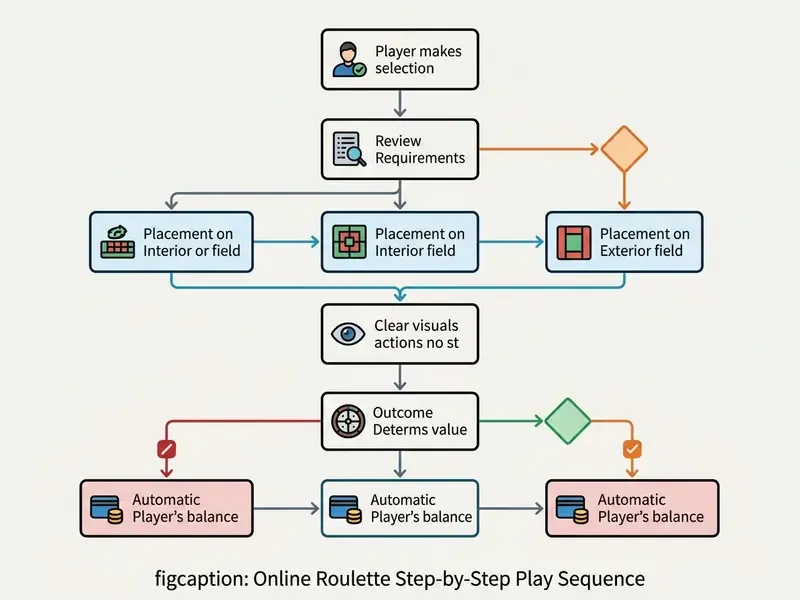
A round follows a strict four-stage sequence: the betting window opens, wagers are placed, the wheel spins, and wins and losses are settled. Knowing this flow keeps your bankroll under control and stops you from missing the bet cut-off, which happens more often than beginners expect.

  1. Betting window opens: the dealer or interface prompts players to pick chip values and place wagers on the roulette table layout.
  2. Bet placed cut-off and spin: players arrange their chips. In live dealer roulette, the dealer calls "No more bets" as the ball is launched. For a spin to be valid, technical standards require the ball to complete at least 4 full revolutions of the outer track before dropping (BCLC, "Rules of Play for Table Games - Roulette", 2026).
  3. Outcome determination: the ball rests in a single numbered slot. The dealer or the system places a marker (the dolly) on the matching table position.
  4. Payout settlement: losing bets are cleared, winning wagers are credited to player accounts at the published paytable multiplier.

Then the table reopens. This short, uninterrupted cycle is precisely why roulette produces strong behavioural reinforcement, and why session-length limits are not a formality.

How a round works from bet

"Roulette players returned to the site faster after winning sessions than after losing ones, and roulette showed shorter return intervals than slots." Behavioural tracking study on between-session chasing in online casinos (2024), cited in Evidence-Based Overview of Online Roulette, Research 2023 to 2026.

Roulette rules: how to play roulette online

Playing roulette online comes down to four steps: pick a licensed platform, pick a table limit you can afford, place digital chips on valid positions, and let the software or the live dealer spin. The basic roulette rules stay the same across RNG software and live casino streams. What changes is speed, interface options, and minimum stakes.

Online roulette round step-by-step flowchart

How to choose a table and place your first bet

Open the casino lobby and read the displayed minimum and maximum table limits before anything else. Do they fit the budget you set for the session? Regulated frameworks require platforms to show minimum and maximum stake caps clearly inside the game interface before chips are accepted (GRA Singapore, "Roulette Game Rules", 2026).

Inside the game, pick a chip denomination from the digital tray. Tap or hover over the position you want on the roulette table layout: a single number, a line intersection, or an outside field such as red/black. Each click adds one chip of that value. Many interfaces enforce a floor, so if your chosen denomination sits below the table minimum, the first click still stakes the minimum. In RNG online roulette, the round starts only when you press "Spin". In live dealer roulette, your bet placed configuration must be final within a fixed countdown, usually 15 to 20 seconds, before the dealer closes the round.

One detail that trips up newcomers: in live lobbies, the limits shown next to a table name usually refer to straight-up limits, not total table exposure. Open the in-game "Limits" panel to see per-position caps for splits, corners, dozens, and even-money fields before you commit anything large.

How to choose a table and

What happens after the wheel stops

When the ball comes to rest, the system logs the winning number, its colour (red, black, or green), and whether it is odd, even, high (19 to 36), or low (1 to 18). The engine then cross-references that number against every bet placed on the layout, instantly.

Losing chips vanish from the grid. Winning positions trigger automatic payout calculations, and winnings land in your balance together with the original stake. Say you place a ₹100 bet on red and number 14 red hits: the 1:1 payout returns ₹200 in total, which is ₹100 profit plus your ₹100 stake. Settlement done, the table opens the next round.

What happens after the wheel stops

Types of bets in roulette: inside and outside bets

Roulette bets split into two families. Inside bets sit directly on numbers within the central grid. Outside bets sit on broader categories around it. Inside bets hit rarely but pay big multipliers; outside bets cover large groups of numbers, win far more often, and pay modestly. Neither family beats the zero.

Inside bets: bets on numbers and adjacent fields

Inside bets target single numbers or small clusters of adjacent numbers on the grid. Because they cover fewer pockets on the roulette wheel, variance is high and dry spells are longer than most beginners expect.

  • Straight up (1 number):chips directly on a single number, including 0 or 00. Pays 35:1. Win probability: 2.70% (European), 2.63% (American).
  • Split (2 numbers):chips on the line between two adjacent numbers. Pays 17:1. Win probability: 5.41% (European) / 5.26% (American).
  • Street (3 numbers):chips on the outer edge of a horizontal row of three. Pays 11:1. Win probability: 8.11% (European) / 7.89% (American).
  • Corner or square (4 numbers):chips on the intersection where four numbers meet. Pays 8:1. Win probability: 10.81% (European) / 10.53% (American).
  • Line or six-line (6 numbers):chips at the outer intersection of two adjacent rows. Pays 5:1. Win probability: 16.22% (European) / 15.79% (American).
Inside bets bets on numbers and

Outside bets: red, black, and other broad bets

Outside bets focus on the broader properties of the winning number and sit along the outer perimeter of the roulette table grid.

  • Red / black:a bet on the colour of the pocket. Pays 1:1. Covers 18 numbers. Win probability: 48.65% (European) / 47.37% (American).
  • Odd / even:a bet on whether the winning number is odd or even, with 0 and 00 excluded. Pays 1:1. Win probability: 48.65% (European) / 47.37% (American).
  • High / low (1 to 18 / 19 to 36):a bet on the lower or upper half. Pays 1:1. Win probability: 48.65% (European) / 47.37% (American).
  • Dozens (1st 12, 2nd 12, 3rd 12):sets of 12 consecutive numbers. Pays 2:1. Win probability: 32.43% (European) / 31.58% (American).
  • Columns:one of three vertical columns of 12 numbers. Pays 2:1. Win probability: 32.43% (European) / 31.58% (American).
Outside bets red, black, and other

Announced bets (call bets) and the French Racetrack layout

In European and French roulette, you can also place "announced" or "call" bets. These cover specific arcs of the wheel itself rather than neat sequences on the numeric grid. They live on an auxiliary oval panel called the Racetrack, which mirrors the physical pocket order instead of the 1 to 36 layout.

  • Voisins du Zéro (neighbours of zero):a 9-chip combination covering 17 numbers around the green zero (22, 18, 29, 7, 28, 12, 35, 3, 26, 0, 32, 15, 19, 4, 21, 2, 25), built from splits, corners, and a trio bet.
  • Tiers du Cylindre (third of the wheel):a 6-chip bet covering 12 numbers opposite the zero sector (27, 13, 36, 11, 30, 8, 23, 10, 5, 24, 16, 33), placed entirely as splits (17/20, 14/11, and so on).
  • Orphelins (orphans):a 5-chip bet on the 8 numbers left out of Voisins and Tiers (1, 20, 14, 31, 9, 17, 34, 6). Four splits plus one straight-up on number 1.
  • Jeu Zéro (zero game):a compact 4-chip version of Voisins covering the 7 pockets closest to zero (12, 35, 3, 26, 0, 32, 15), including a straight-up on 26.
  • Neighbours (Voisins de X):a 5-chip bet on a chosen number plus the two pockets to its left and right on the wheel. Most live interfaces let you save this pattern as a favourite.
Announced bets call bets and the

Announced bets do not change the house edge. Each component is an ordinary inside bet paid at its normal multiplier. They simply spread exposure across a physical arc of the wheel, which is why experienced players use them for sector coverage, not for any statistical advantage. Worth repeating, because the myth is stubborn.

Comprehensive Comparison of Roulette Bet Types, Payouts, and Odds

Bet NameCategoryNumbers CoveredPayout RatioEuropean Win Probability (37 Pockets)American Win Probability (38 Pockets)
Straight UpInside135:12.70%2.63%
SplitInside217:15.41%5.26%
StreetInside311:18.11%7.89%
CornerInside48:110.81%10.53%
Six LineInside65:116.22%15.79%
Dozen / ColumnOutside122:132.43%31.58%
Red / BlackOutside181:148.65%47.37%
Odd / EvenOutside181:148.65%47.37%
High / LowOutside181:148.65%47.37%
Five-Number Bet (0, 00, 1, 2, 3)Inside (American only)56:1Not available13.16% (house edge 7.89%)

Inside bets pay more per hit but bring long strings of blank spins, since single-spin hit rates are low. Outside bets return wins far more often, yet their 1:1 and 2:1 multipliers cannot outrun the negative expectation created by the green zero across a long session. That is the trade-off in one sentence, and no bet combination escapes it.

"Regardless of bet combination, the average expected value of a wager remains negative and exactly equal to the house edge, confirmed analytically and through Monte Carlo simulation." Gaming Conference Proceedings, "Analysis of Paroli and Let-It-Ride Systems" (2026), cited in Evidence-Based Overview of Online Roulette.

European, American, and French roulette: which version to choose

The real difference between variants is wheel geometry plus the special zero rules. Those two factors set the house edge and the long-term return-to-player (RTP) percentage. Choosing European or French over American roulette is one of the few decisions that measurably lowers your expected hourly loss.

European roulette and French roulette

European roulette uses a 37-pocket wheel: numbers 1 to 36 and a single green zero. That single zero fixes the house edge at 2.70% (1/37) across standard bets, which corresponds to 97.30% RTP.

French roulette uses the same 37-pocket single-zero wheel, but adds defensive rules on even-money bets, namely La Partage or En Prison:

  • La Partage: if the ball lands on green 0, you lose only half of your even-money stakes (red/black, odd/even, high/low). The other 50% comes back immediately.
  • En Prison: if green 0 hits, even-money wagers are locked "in prison" for the next spin. Win that spin, and the original stake is returned in full, without profit.

These rules halve the even-money house edge to 1.35% (0.5 × 1/37, RTP 98.65%), which makes French roulette mathematically the best roulette format widely available online (RouletteSheet, "French Roulette Rules & Odds", 2026). One caveat that promotional pages rarely mention: inside bets on a French table stay at 97.30% RTP. The discount applies only to even-money positions.

European roulette and French roulette. European

"Analytical models confirm that choosing a variant with fewer zero pockets is one of the few ways to reduce expected losses without changing the type of game." Gaming Conference Proceedings, "Analysis of Paroli and Let-It-Ride Systems" (2026); Pozdnyakov, "Gambler's Ruin for Correlated Random Walks" (2025), cited in Evidence-Based Overview of Online Roulette.

American roulette and double zero

American roulette adds a second green sector, the double zero (00), for 38 pockets in total. The numbers follow a different non-sequential order compared with European wheels. Clockwise from 0 it runs 0, 28, 9, 26, 30, 11, 7, 20, 32, 17, 5, 22, 34, 15, 3, 24, 36, 13, 1, 00, 27, 10, 25, 29, 12, 8, 19, 31, 18, 6, 21, 33, 16, 4, 23, 35, 14, 2.

Two zero pockets nearly double the baseline house edge to 5.26% (2/38) on all standard bets. American roulette also carries the unique "five-number bet" on 0, 00, 1, 2, and 3, which pays 6:1 at a punishing 7.89% edge: E[X] = (6 × 5/38) − (1 × 33/38) = −3/38. Unless a specific promotion genuinely compensates for it, single-zero variants are the better call.

American roulette and double zero. American

E-E-A-T fact check: always read the in-game rules menu before real-money bets. Tables can look identical while payouts, side bets, and zero handling differ by software provider. Single-zero European wheels hold a fixed 2.70% edge; French wheels with La Partage drop the even-money edge to 1.35%; double-zero American wheels raise the edge to 5.26% across standard fields.

Multiplier and live game show roulette variants

Modern studios go beyond the classic paytable by layering RNG multipliers onto physical live wheel spins. These hybrids deliberately cut standard straight-up payouts in order to fund the big multipliers. Volatility goes up. Long-term expectation does not improve.

  • Lightning Roulette and XXXtreme Lightning (Evolution):straight-up pays 29:1 instead of 35:1. Each round strikes 1 to 10 "Lightning Numbers" with multipliers from 50x up to 2,000x through Chain Lightning and Double Strike. Lightning Roulette won Product Innovation of the Year at the Global Gaming Awards and runs in several native-language studios, Hindi included.
  • Mega Fire Blaze Roulette (Playtech):a bonus round where landing in fire zones opens multiplier grids reaching up to 10,000x, plus in-game jackpots.
  • Quantum Roulette (Playtech):an American-layout live variant in a futuristic studio, applying "Quantum Multipliers" of 50x to 500x to selected straight-up numbers.
  • Double Ball Roulette (Evolution):a patented compressed-air launcher releases two balls onto one wheel. Two winning numbers per spin, dual-win outside bets, and a 1,300:1 payout if both balls land in the same selected pocket.
  • Power Up Roulette and Gold Vault Roulette:stacked multipliers up to 8,000x and gold-bar multipliers of 50x to 500x respectively, with carry-over mechanics between rounds.
  • 100/1 Roulette (RNG):swaps the 37-pocket track for a 105-pocket wheel (1 to 100 plus 5 green shapes). Straight-up wins pay 100:1, which brings high-volatility mechanics into RNG play.
Multiplier and live game show roulette
Variant NameDeveloperWheel TypeStraight-Up Base PayoutMax Multiplier / Feature
European ClassicStandardSingle Zero (37 Pockets)35:135:1 (Fixed)
Lightning RouletteEvolutionSingle Zero (37 Pockets)29:1500x
XXXtreme LightningEvolutionSingle Zero (37 Pockets)19:1 to 29:12,000x
Mega Fire BlazePlaytechSingle Zero (37 Pockets)29:110,000x
Double BallEvolutionSingle Zero (37 Pockets)17:1 (1 ball)1,300:1 (2 balls, same pocket)
100/1 RouletteInspired GamingCustom (105 Pockets)100:1100:1 (Fixed)

How to read these numbers. A reduced base payout is not generosity, it is the funding mechanism. If straight-up falls from 35:1 to 29:1, the multiplier feature has to give back those missing 6 units on average simply to hold RTP level with a classic wheel. So treat multiplier tables as a volatility choice, never as an edge reduction, and check the published RTP in the game info panel before staking real money.

Roulette demo, RNG games, and live dealer roulette

Online casinos offer roulette in three operational formats: free demo mode, automated RNG software, and live dealer video streams. Which one suits you depends on your goal: risk-free practice, maximum speed, or a real croupier on camera.

RNG roulette vs live dealer roulette technical architecture diagram

Roulette demo: how the free mode works

Roulette demo is a risk-free mode running on virtual credits instead of real money. The engine, hit frequencies, and table layouts match the real-money version, so you can rehearse bet placement, judge interface responsiveness, and watch how variance swings a balance across different bet types.

Demo mode is a controlled sandbox for testing betting structures without financial exposure. Updated: operator rule pages state that demo balances are simulated credits with no cash value, so demo results are typically not convertible or withdrawable. The exact behaviour, including session resets, balance top-ups, and which features unlock, is set by the individual operator and the specific demo build, so confirm it in the game info panel. Access rules vary too: many RNG demos launch straight from the lobby, while some operators and jurisdictions require a logged-in account first.

Bonuses generally cannot be triggered inside free play, and live dealer tables are the format least likely to offer a genuine demo. Most live lobbies give only a spectator or view-only mode, because every round burns a real physical spin in a broadcast studio. Practical takeaway: rehearse in RNG demo, then move to live tables with real stakes and pre-set limits already in place.

Roulette demo how the free mode

Classic online roulette with RNG

Classic online roulette uses a software Random Number Generator to settle each spin instantly. No human dealer. You press "Spin", the algorithm draws a certified pseudo-random outcome, and that outcome maps to a wheel compartment.

For integrity, independent labs such as iTech Labs and GLI (working under iGaming certification standards like GLI-19) test RNG algorithms against statistical batteries, including the Marsaglia Diehard series, across datasets of 10,000 to 100,000 consecutive outcomes (GLI-19 Interactive Gaming Standards; iTech Labs Certification Framework). These audits check that results are unpredictable, non-repeating, and statistically uniform over time. UK Gambling Commission RTS 7 sets the same core requirement: outputs must be acceptably random, unpredictable, and statistically tested before release, with no predictability introduced by seeding or re-seeding.

The practical upside of RNG tables: micro-stakes access (single-spin stakes from as little as ₹1 or 1p at some operators), instant resolution with no waiting on other players, and full demo availability for strategy rehearsal.

Classic online roulette with RNG. Classic

Live dealer roulette and playing with a real dealer

Live dealer roulette sits between digital convenience and land-based atmosphere. Real croupiers run physical wheels in dedicated studios, and multi-angle HD streams reach player devices in real time.

These systems use Optical Character Recognition to read the physical wheel and the settled ball, turning a pocket position into digital data for the betting engine. Players act through a touch overlay, and live chat allows text messages to the dealer. Regulators treat this equipment separately from software RNG: UKGC RTS 17 requires video surveillance of dealer activity in live studios to confirm dealing procedures, and Connecticut's 2025 Live Dealer Online Gaming Equipment Technical Specifications set controls for the streaming environment itself.

Live dealer roulette and playing with

"The Lancet 2024 Commission notes that live online casinos blur the line between remote and in-person play, increasing betting intensity through immersion." Lancet Public Health Commission on Gambling (2024), cited in Evidence-Based Overview of Online Roulette.

Pace differs sharply between live tables. Standard tables run 45 to 60 second cycles. Evolution's Speed Roulette compresses that to roughly 25 seconds spin to spin, about half a standard round. Speed Auto Roulette delivers up to 2,500 automated games per day, and Instant Roulette runs 12 synchronised auto wheels so a ball is always about to drop. More rounds per hour means more expected loss per hour at the same edge. Pace is a bankroll variable, not just a comfort preference.

Operational Comparison Matrix: Demo, RNG Online, and Live Dealer Formats

Feature / ParameterRoulette DemoRNG Online RouletteLive Dealer Roulette
Human Dealer PresentNoNoYes (HD Streamed)
Outcome DeterminantRNG Software EngineCertified RNG AlgorithmPhysical Wheel & Ball (OCR Tracked)
Real Money StakingNo (Virtual Credits)YesYes
Round Speed & Pace MetricsInstant / Player-Triggered (0.5 to 2s per spin)Fast (Instant to 5s per spin)Standard: 45 to 60s | Speed Roulette: 25s | Instant Roulette: multi-wheel continuous
Operational CapacityUnlimited localized spins10,000+ RNG cycles/min per serverAuto Roulette: up to 2,500 automated physical spins per 24h cycle
Typical Minimum StakeNone (virtual)₹1 to ₹10 ($0.01 to $0.10)₹50 to ₹100 ($0.50 to $1.00); VIP up to ₹500,000+
Demo AvailabilityYes (Free Access)Often AvailableRare / View-Only Mode
Mobile UsabilityHighHigh (Low Bandwidth)High (Requires Stable 4G/5G/Wi-Fi)

Roulette real money: how to choose a casino and terms of play

Moving to roulette real money raises the bar on due diligence. You want valid licensing, transparent payment flows in Indian Rupees, table limits that match your bankroll, and bonus rules written in plain language rather than fine print.

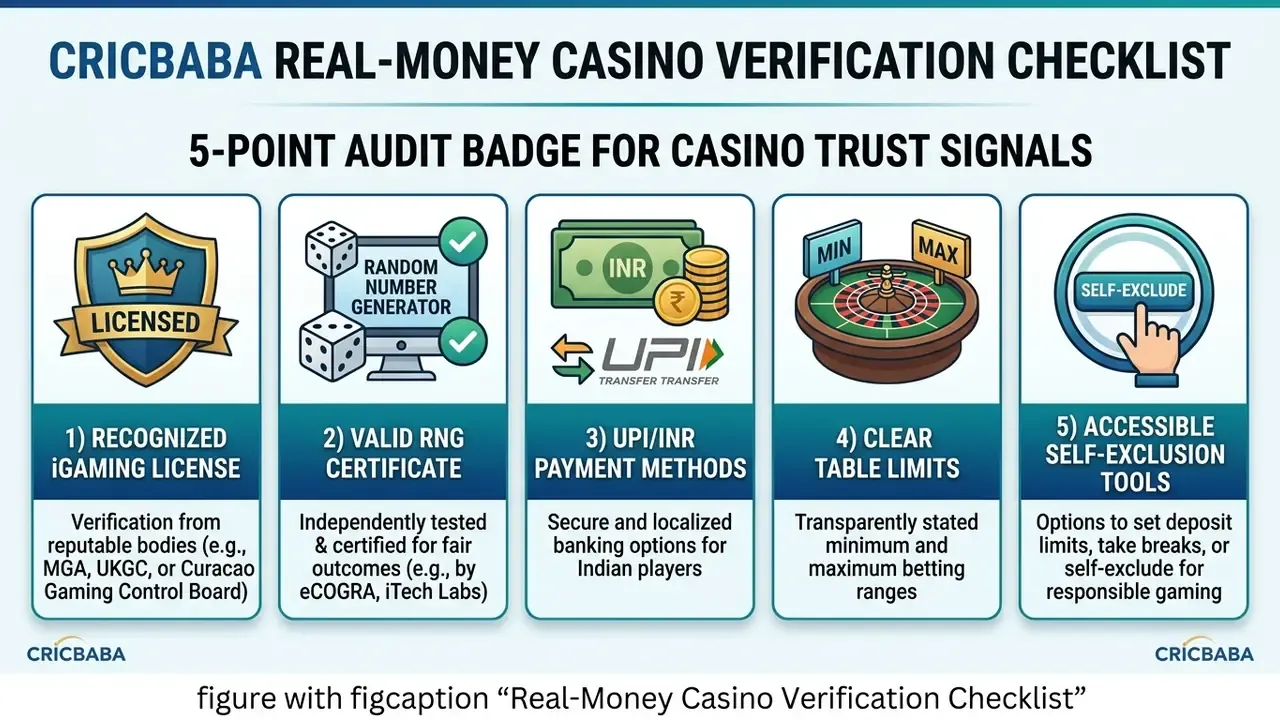
Online casino safety and licensing verification checklist

What to check before money bets

During an editorial audit of an India-facing casino platform aimed at English-speaking users, we tested registration, INR deposits via UPI, and a live roulette withdrawal. The deposit processed instantly in local currency. The withdrawal, however, was held pending identity verification. Once we submitted standard KYC documents (Aadhaar/PAN copy plus a recent bank statement matching the UPI account name), the account cleared within 24 hours and funds reached NetBanking without surprise handling fees. Not dramatic, but that is roughly the timeline to expect.

"A 2025 study found that online casino players more often display high neuroticism, low social support, and smartphone dependence compared with non-online gamblers." Psychological profile study of online gamblers (2025), cited in Evidence-Based Overview of Online Roulette.

Four checks before you deposit real money:

  1. Licensing status: confirm an active licence from a recognised regulator such as MGA or PAGCOR before you treat the brand as a trustworthy online casino platform.
  2. Payment methods and INR support: look for UPI, IMPS, and NetBanking so you avoid international conversion charges on every deposit and payout.
  3. KYC and withdrawal policies: verify that the rules allow balance cashouts at any time and clearly list required documents (UKGC Technical Standards; Gibraltar Gambling Commissioner Guidelines). UK consumer-protection rules explicitly require a player's deposit balance to stay withdrawable at any time, even while a bonus is pending.
  4. Responsible gaming limits: check whether you can set daily, weekly, or monthly deposit caps inside the account panel before your first deposit. GamCare's guidance is blunt: "Set deposit limits with individual gambling sites… stick to one gambling account and set a limit, then self-exclude from any other sites."
Four checks before you deposit real

Red flags: how to spot an unsafe roulette site

  • No verifiable licence. A logo in the footer with no licence number, or a regulator register that returns no match for the operator's legal entity.
  • No RNG or lab certification. No iTech Labs, GLI, eCOGRA, or equivalent test reports, or certificates naming a company other than the site operator.
  • Withdrawal friction after the fact. KYC demands appearing only after a win, rolling "additional verification", or a pending-withdrawal timer that keeps resetting.
  • Impossible bonus terms. Wagering of 60x to 500x, 3 to 7 day clearing windows, max-bet clauses buried in T&Cs, or roulette quietly excluded from contribution.
  • Non-standard payouts. Straight-up paying under 35:1 on a classic wheel with no disclosed multiplier feature, or a "European" table that hides a 00 pocket.
  • Missing responsible-gambling tools. No deposit limits, no reality checks, no self-exclusion, no visible 18+ statements.
  • Support that evaporates. Silent live chat, no company address, only a web form, or bonus disputes answered by account closure with no explanation.
  • Unregistered payment intermediaries. Requests to send funds to a personal UPI ID or an individual's bank account instead of a corporate merchant.
Red flags how to spot an

Roulette casino terms: limits, game options, and offers

When you compare real-money roulette tables, start with the posted table limits. They define the minimum single-spin stake (say ₹50) and the maximum caps per position or per table (say ₹100,000). Regulated frameworks back this up: Colorado's gaming rules require minimum and maximum table bets to be posted on the game itself, and Arizona's roulette appendix caps maximum wagers at $100,000 with conspicuous display. High rollers should study straight-up position caps; casual players should simply confirm the minimum fits a session budget they can lose without stress.

If you claim a welcome deposit bonus, read the game weighting contribution rules twice. In most roulette casinos, slots contribute 100% toward wagering, while roulette wagers often contribute only 5% to 10%, or nothing at all, because of the low house edge and the option of near-hedged combinations such as equal stakes on red and black. Verification note: the exact percentage is operator-specific and lives in the promotion's own terms. Published examples range from full exclusion to 5% (Bovada's bonus terms assign roulette 5% contribution and cap the max bet at 20% of the deposited amount during bonus play). Treat 5% to 10% as a typical band, not a universal rule.

Roulette casino terms limits, game options

"A 2025 comparative analysis in Great Britain found that casino-game participation is associated with higher problem-gambling severity than lottery participation." Gambling Research Glasgow, comparative analysis of gambling products and problem gambling (2025), cited in Evidence-Based Overview of Online Roulette.

Wagering weighting and bet size benchmarks

Table minimums and wagering contributions differ a lot between RNG and live environments:

  • Micro-stakes RNG tables:software games accept single-spin stakes from ₹1 to ₹10 ($0.01 to $0.10), which suits small bankrolls and demo-to-real transitions.
  • Live dealer table limits:studio streaming costs push live minimums to roughly ₹50 to ₹100 ($0.50 to $1.00), scaling to ₹500,000+ ($5,000+) on dedicated VIP tables. For comparison, PAGCOR's licensed-casino manual lists land-based roulette minimums of USD 100 per spin on standard tables and USD 200 per spin on high-roller tables.
  • Wagering requirements in the market:published requirements across India-facing brands run from 0x (no-wagering offers) through 40x to 60x, up to 500x at some crypto-first platforms. The multiplier alone means nothing without the weighting clause next to it.
Wagering weighting and bet size benchmarks

Worked INR example, and why roulette is a poor bonus vehicle. Take a ₹10,000 deposit bonus with a 40x requirement. That is ₹10,000 × 40 = ₹400,000 in qualifying turnover. On slots at 100%, every ₹100 wagered counts as ₹100. On roulette weighted at 10%, every ₹100 counts as ₹10, so clearing the same bonus would demand ₹4,000,000 of roulette turnover. Against the bonus itself, the effective requirement jumps from 40x to 400x.

Wager on rouletteCounts toward wagering at 10%Counts at 5%Counts at 100% (slots)
₹100₹10₹5₹100
₹1,000₹100₹50₹1,000
₹10,000₹1,000₹500₹10,000

Practical rule: do not activate a casino bonus for roulette play unless weighting exceeds 20% or the offer is explicitly "No Wagering" (0x). If roulette is your game, decline the bonus and keep your deposit balance fully withdrawable. Boring advice, and it protects real money.

Responsible gambling alert: real-money roulette carries genuine financial risk. Never gamble with funds needed for essential living expenses. Set deposit and loss limits before you start, and treat casino gaming as paid entertainment, never as income. If control starts slipping, use the platform's self-exclusion tools and reach out to BeGambleAware (begambleaware.org, helpline 0808 8020 133) or GamCare. Note that GamCare states it does not run self-exclusion schemes itself; exclusion is applied by licensed operators or linked national schemes.

Roulette strategy: what to consider and which approaches to avoid

A roulette strategy is a staking framework for spreading a bankroll across rounds. Useful for discipline, yes. But no system and no progression alters the game's odds or cancels the negative expectation built into the zero.

Disclaimer: this information is general and does not replace advice from a qualified professional. No betting strategy guarantees a win. Every system below carries risk of loss, including total loss of the funds staked.

How roulette strategies relate to odds and house edge

Every spin on a fair wheel is an independent event. Spin history has zero influence on what comes next, because the wheel has no memory. Red ten times in a row? Zero twice? The probability of red on the next single-zero spin is still exactly 18/37, or 48.65%.

"2023 experiments with more than 10,000 participants showed that having a choice in a lottery does not improve winning odds, but lets players act on mistaken beliefs about 'lucky' options." Psychological Science experiments on choice and perceived control in random lotteries (2023), cited in Evidence-Based Overview of Online Roulette.

That study explains the demand for systems rather neatly. The interface offers choice, choice feels like control, and the distribution stays fixed regardless. Popular roulette strategies resize bets according to past results, yet the house edge does not budge:

  • On single-zero European wheels, every standard bet carries an expected long-term loss of 2.70% per unit staked.
  • On double-zero American wheels, standard bets carry 5.26%, rising to 7.89% on the five-number bet.
  • On French even-money bets with La Partage, the figure drops to 1.35%, the lowest available in mainstream online roulette.

Systems reshape the volatility profile of a session, producing either frequent small wins or rare heavy losses. What they cannot do is lift the expected value E[X] above zero.

That study explains the demand for

"A 2025 gambler's-ruin model for correlated random walks proves that with a house edge present, the probability of complete ruin tends to 1 as the number of bets grows." Pozdnyakov, "Gambler's Ruin for Correlated Random Walks" (2025), cited in Evidence-Based Overview of Online Roulette.

Why systems do not guarantee a win

Progressive betting collides with two hard walls: table maximums and a finite bankroll.

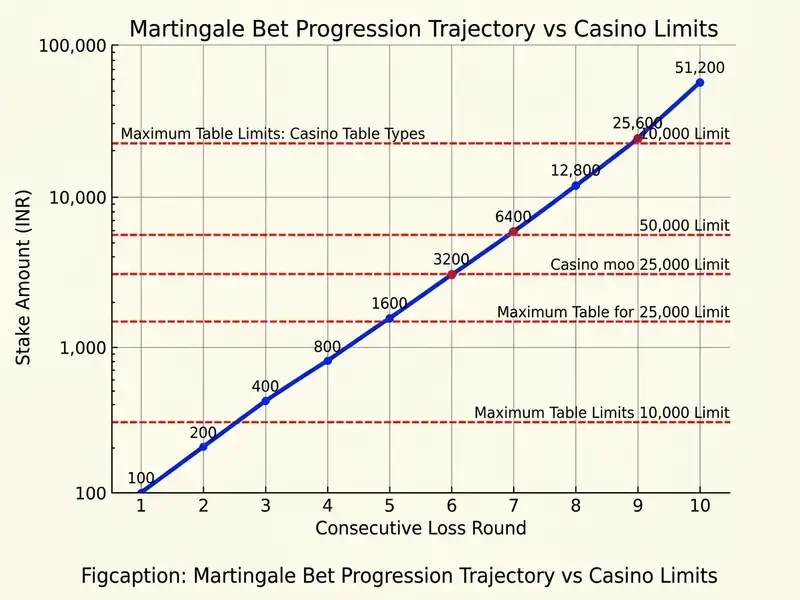
  • Martingale (loss progression):double the stake after every loss (₹100 → ₹200 → ₹400 → ₹800 → ₹1,600). The theory says one win recovers everything plus a single unit. In practice, 7 or 8 losses in a row inflate the required stake beyond the table cap or beyond your balance, and the recovery logic collapses.
  • Fibonacci:stakes follow 1, 1, 2, 3, 5, 8, 13, moving one step forward after a loss and two back after a win. Growth is gentler than Martingale, yet a long cold run still pushes stakes past table limits.
  • D'Alembert:add one unit after a loss, remove one after a win. Linear growth, calmer swings, and the same negative expectation accumulating over total volume wagered.
  • Paroli (reverse Martingale) and Let-It-Ride:stakes rise only after wins, so a losing streak costs one base unit at a time. The catch is that profit depends entirely on catching consecutive wins, and one loss at the top of the progression wipes the run.
Why systems do not guarantee a

Updated: a 2026 mathematical analysis evaluated Paroli and Let-It-Ride with recurrence formulas cross-validated by Monte Carlo simulation. It confirmed that win-progression systems dodge Martingale's exponential escalation, yet the expected gain per unit staked over long sequences stays strictly negative and exactly equal to the wheel's house edge. The systems differ in variance and normalised risk measures, not in expectation (Gaming Conference Proceedings, "Analysis of Paroli and Let-It-Ride Systems", 2026).

Graph showing Martingale betting system stake escalation hitting table limits

So what is left that actually helps? Avoid paid "guaranteed winning formulas" and prediction software, full stop. Then apply plain bankroll management: choose single-zero European or French tables, set a hard stop-loss before you open the game, use demo mode while you learn the interface, prefer slower round cycles when your bankroll is modest, and price every spin as entertainment spend rather than an investment.

Quick-decision guide: which roulette table fits your profile?

Decision tree flowchart for choosing online roulette variants

Run through this short algorithm before you open a table:

  1. Learning the interface, zero budget? Use European RNG demo mode. Same math, no exposure, unlimited repetitions.
  2. Want the smallest mathematical disadvantage? Choose French live roulette with La Partage and bet even-money positions only (1.35% edge). Mixing in straight-ups pulls you back to 2.70%.
  3. Small bankroll, maximum spins per rupee? Pick RNG European tables with ₹1 to ₹10 minimums, and skip live tables until your bankroll comfortably covers 100 or more minimum stakes.
  4. Chasing large, rare payouts and ready for deep drawdowns? Lightning, XXXtreme, or Mega Fire Blaze, knowing straight-up drops to 29:1 and variance climbs steeply.
  5. Prefer atmosphere and a human dealer? Standard live dealer roulette at 45 to 60 second cycles. Choose Speed or Instant Roulette only once your loss limits are set, because pace multiplies expected hourly loss.
  6. Never choose: American double-zero wheels when a single-zero table is on the same lobby page, and never the five-number bet at 7.89%.

One last nudge: if none of these profiles feels comfortable yet, staying in demo for another week costs you nothing.

Run through this short algorithm before

FAQ: online roulette questions answered

Is online roulette legal in India?

There is no single national online casino law. Gambling sits mainly with the states, the Public Gambling Act, 1867 predates online play, and states such as Andhra Pradesh and Telangana have imposed strict local prohibitions. Most India-facing sites hold offshore licences (MGA, PAGCOR, Curaçao), which regulate the operator abroad but say nothing about legality in your state. Check your state's current rules and consider professional advice first.

Which roulette variant is best for a beginner?

European roulette (single zero, 2.70% edge) in demo mode first, then real money at low RNG stakes. If your platform carries French roulette with La Partage, even-money bets there hold the lowest edge available at 1.35%. Skip American roulette at 5.26%.

Can you actually win with the Martingale system?

You can win short sessions. You cannot win reliably over time. Doubling after each loss escalates fast: starting from ₹100, ten straight losses require ₹51,200 on the next bet, and cumulative exposure passes ₹100,000. Table maximums and a finite balance break the recovery logic, while the 2.70% or 5.26% edge applies to every rupee staked no matter the sequence.

Do demo winnings convert to real money?

No. Demo balances are simulated credits with no cash value, and bonuses generally cannot be triggered in free play. Demo exists for interface familiarity and variance observation, not profit.

Why do my roulette bets barely move my bonus progress?

Game weighting. Roulette often contributes only 5% to 10% toward wagering. A ₹10,000 bonus at 40x needs ₹400,000 of 100%-weighted turnover; at 10% weighting on roulette that becomes ₹4,000,000, an effective 400x. Decline bonuses for roulette unless weighting exceeds 20% or the offer is 0x.

Is live dealer roulette fairer than RNG roulette?

Neither is inherently fairer. RNG outcomes are certified by independent labs (GLI-19, iTech Labs, Marsaglia Diehard tests over 10,000+ outcomes) under standards such as UKGC RTS 7. Live wheels are physical devices tested for random distribution over extended play, with studio surveillance required under RTS 17. The meaningful differences are pace, stake minimums, and immersion, not integrity.

What multiplier can Lightning Roulette pay?

Lightning Roulette applies 50x to 500x multipliers to Lightning Numbers, XXXtreme Lightning reaches 2,000x through Chain Lightning and Double Strike, and Playtech's Mega Fire Blaze can reach 10,000x in bonus rounds. The price is a lower base payout: straight-up drops from 35:1 to as little as 19:1 or 29:1.

What documents will I need to withdraw?

Standard KYC on India-facing platforms means a government ID (Aadhaar and/or PAN), proof of address, and a bank statement or screenshot matching the UPI or NetBanking account name. In our editorial test, verification finished within 24 hours once matching documents were submitted.